Thursday, July 10, 2014

So What is a ONE SHEET Anyway?


By Edie Melson
For those of you getting ready for a big writers conference, you may have heard about the need for a One Sheet. This tool is also known as a Pitch Sheet. It's a one page presentation of the project you're pitching to an editor or agent. Today I'll be explaining how to put one together.

Click here to see an example of my cozy mystery, DEAD RINGER one sheet. This sheet led to multiple requests for proposal and full manuscripts. To answer your question, no, it's not been published. I sent it out too soon and killed my chances -- but that's fodder for a future post!

There are three basic components of a one sheet -- the project blurb, specifics about the project and the author's bio -- including a picture and contact info. We'll take each component individually and explain what's included. 


An Image to Illustrate Your Concept

A lot of one sheets include an image to set the mood. This isn't a requirement, but we're seeing it more and more. You can buy an image, upload one of your own, or use one that's copyright free.


The Project Blurb

For this section, think back cover copy. This is NOT the place for a full synopsis. You want this section to read like the blurb on the back cover of a book. You should give more information than just a hook. Make sure you include enough for the editor or agent to get a good sense of the story. 


Project Specifics

This is where you give some of the details and they're slightly different for fiction and non-fiction. 

Fiction
Genre -- like Romance or Suspense.
Manuscript Length -- this doesn't have to be an exact word count, just an approximation.
Target Audience -- every book should be written with an audience in mind. I know, we all think our book will appeal to a wide range of readers -- and that may be true. But this tells the potential editor or agent how to market the book. It will help sell a publishing house on your manuscript by defining the reader you're writing for. 
*There isn't a section here for completion date because it's understood that a manuscript must be complete before it's submitted. It's okay to pitch an uncompleted manuscript with a one sheet, but it's rare for anyone to look at it as a submission until it's complete. 

Non-Fiction
Projected Completion Date -- the reason you don't have a non-fiction manuscript completed is because publishers like to have a say in the overall concept.
Manuscript Length -- since it's not completed, this is just an estimate.
Target Audience -- just like in fiction, you need to focus in on who specifically you're targeting with this manuscript.
Similar Titles, also known as Comparables -- you don't have to include this, but it's nice if you have room.

Author Info

This is where you need to include a recent picture, personal bio, contact information and social media information. 
Picture -- this should be a professional headshot. That doesn't mean it has to be stuffy, but it needs to be of professional caliber.
Bio -- keep this short and relevant. The person reviewing your one sheet is going to want to know your experience. That includes writing experience and experience with your subject matter. In other words, why are you the person to write this book?
Contact Info -- You need to include your email address, phone number, and website URL. This is no need to include your physical address. It just takes up valuable real estate without adding anything.

All of these individual components will give you an effective one sheet. Be sure to post any questions or comments you have. 

Edie Melson is the author of numerous books, as well as a freelance writer and editor. Her blog, The Write Conversation, reaches thousands each month. She's the co-director of the Blue Ridge Mountains Christian Writers Conference and the social media mentor at My Book Therapy. She's also the military family blogger at Guideposts.com, social media director for Southern Writers Magazine and the senior editor for NovelRocket.com. Connect with her on Twitter and Facebook. 

Wednesday, June 18, 2014

Researching Carolina Rice Plantations


By Elva Cobb Martin

In my research for a future novel, as well as for magazine articles, I recently took the annual two-day Rice Plantation Tour sponsored by an historic Episcopal Church in Georgetown, South Carolina. The church parish was founded in 1721.

Prince George Winyah Episcopal Church

Did you know that rice was once king in South Carolina? Some would even say more so than the King of England ever was.

From colonial times until the Civil War, rice growing made the Carolina Low Country one of the wealthiest areas in the United States. In fact, by the Revolutionary War, rice, nicknamed "Carolina Gold" made Charleston, South Carolina, the richest colonial town in America with twice the wealth of Philadelphia and New York, according to the ETV program, When Rice Was King.

Wednesday, June 11, 2014

Resources for Authors and Their Research

I write historical fiction, and researching for my novels brings me the same excitement Alan Quartermain must have felt hunting for King Solomon's Mines.

I've been known to spend an entire day in a library scribbling notes from someone‘s diary, spending a wallet of quarters making copies of maps and old newspapers, and trekking from one book or document to the next with a perseverance Lewis and Clark would have applauded. I enjoy the chase when one clue leads me to the next, to the next…

The South Caroliniana Library
When I venture into a library or archives and history department, wander among the shelves, and delve into boxes of documents, I'm transported into the past and into unknown territory. My efforts are often rewarded when tidbits of information surface and shine like specks of gold in the bottom of a miner‘s tin.

For example, one of the characters in my Civil War era novel, A Perfect Tempest, is based on Oqui Adair, a Chinese gardener, who was briefly mentioned in a SC State Hospital Board of Regents report found in the SC Archives and History Department. The name of the novel itself comes from a quote from General Sherman’s diary that was featured in an issue of the Daily Southern Guardian newspaper. I found it in the South Caroliniana library.

Discovering new resources is always great fun, too. Once, I put an ad in the Civil War Times asking for information about Union officers who were imprisoned in Camp Asylum, a prisoner-of-war camp situated on the SC State Hospital grounds in Columbia, SC, from December 1864 until February 1865, when Sherman‘s troops burned the city. Two gentlemen, one from Maine and one from California, answered my ad, and we wrote to each other over a period of several months. They both sent me materials about relatives imprisoned at Camp Asylum—a photograph, a letter, and an excerpt from a diary.

Sometimes people serve as living, breathing archives. When I was working on my novel, The Chamomile, that takes place in South Carolina during the Revolutionary War, my main characters, a couple who are traveling in the swamps with Francis Marion, decide to get married. I wanted the men to build a honeymoon hut and I needed to know the kind of flowers the campfollowers would decorate with. So, I called Rudy Mancke, a naturalist and a walking encyclopedia of flora and fauna, and asked him what would have been blooming in the South Carolina swamps in May 1781. He was so receptive to my questions and so excited about what I was trying to do, I could hardly write fast enough to keep up with him. What a wealth of knowledge he is! We had the most delightful conversation.

I’ve put together a list of resources when researching for your novels.

Researching – Where to Look

1. Internet (Google; blogs; websites)
2. Library/Archives and History Departments; Books, research rooms
3. Diaries/letters 
4. Newspapers/magazines 
5. Pamphlets
6. Advertisements/catalogs
7. Cookbooks
8. Annual reports
9. Graduation programs
10. Thesis/bibliography
11. Music books
12. Pattern books
13. Architects drawings 
14. Movies 
15. Other novels written during the time period
16.  Museums
17. Visits to actual sites (tours that let you "breathe the air")
18. Reenactments
19. Cemeteries (great resources for names)
20. Photographs
21. Movie productions
22. People—walking archives

Colonial American Cemetery


Susan F. Craft authored the SIBA Award-winning Revolutionary War novel, The Chamomile. The two sequels to The Chamomile, entitled Laurel and Cassia will be release in January 2015 and later that year, respectively. She is represented by Linda S. Glaz, Hartline Literary Agency.

Wednesday, June 4, 2014

Marketing 101

by Andrea Merrell

Marketing … promotion … social media—what’s a writer to do?


When I first started writing, I didn’t consider the complexities of getting published or establishing a platform. Fortunately, I was blessed with great advice: “Find a critique group, attend writers’ conferences, and network, network, network.” As an editor, I pass along this advice to my clients and stress the importance of promoting their books—whether traditionally published or self-published.

With the recent launch of my first book, Murder of a Manuscript, I have now moved into the marketing arena. Here are a few suggestions that have produced positive results:

Wednesday, May 21, 2014

How Do Writers Who Face Pain Write?

by Patty Smith Hall

Writers are always told that one key to getting a publishing contract is to "put your backside in a chair and write!" But what if you physically can’t sit for any length of time without being in a great deal of pain? What do you do then?

So how do writers who face chronic, debilitating pain write?

Stay in Constant Prayer

Dealing with constant pain usually does one of two things to a person; either it sends you running in every direction, chasing every lead for a reason for the pain, a ‘why’ behind the agony or it drives you to your knees. I’ve done both. But one very important question I’ve put before God (besides the whole ‘why me?’) is if writing is in His plan for me. I wanted to make sure I was in God’s will and had to prepare myself if God required me give up writing or the hope of publication. It’s a dark place at times, but also one where your faith is stretched in new ways each and every second of the day.

Equally important is the need to be ready to handle the pain if He sends confirmation to continue writing. Working through chronic pain or illness takes a inhuman toughness only God can give. So I’ve turned even more to His Word for encouragement. Sticky notes on my computer with scriptures--my favorites are 2 Corinthians 12:9 and Romans 8:28.

Wednesday, May 14, 2014

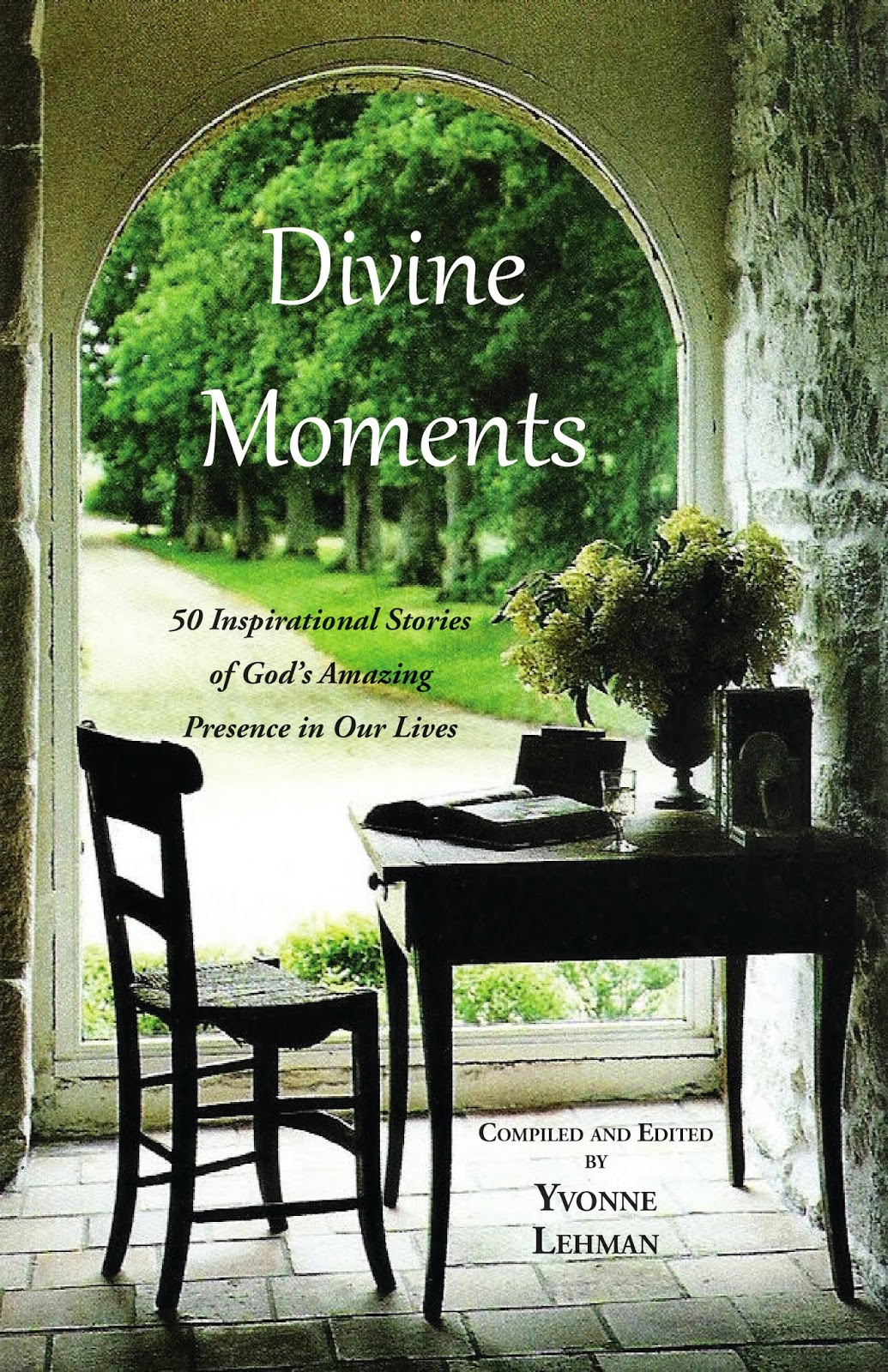
Divine Moments


by Yvonne Lehman

Some of you reading this blog know about this wonderful book just released by Grace Publishers because you are among the contributors. For the benefit of those who aren’t familiar with it’s beginning, I’d like to mention it and thank the ACFW-SC contributors.

One evening, after a day of participating in the 2013 Blue Ridge Mountains Christian Writers Conference, several us sat in the beautiful lobby of Mountain Laurel hotel on the campus of Ridgecrest Conference Center in North Carolina.

Cindy Sproles told a story that had us all gasping with amazement of how God showed up in an almost unbelievable way. Someone else, then others began to remember and share their stories. Some were sweet, some humorous, others serious, but all were about knowing his presence with us. I thought of the praise song, “Our God is an Awesome God,” in which the words are repeated over and over. I’ve often wanted to say, “Go further. Don’t just repeat the words. Tell me in what ways you are amazed by God.”

Wednesday, May 7, 2014

Use What You've Got--Learning to Write in Bits & Pieces of Time

by Edie Melson

I had always believed that I needed at least an hour, and preferably three, to make any progress at all with my writing.

I couldn’t have been more wrong.

In the past year, I’ve learned how to use the time I have, even if it’s just fifteen minutes. Today I want to share with you the things I do to increase my productivity when life intrudes.

1. Decide to use what you’ve got. This is the biggest part of the puzzle. If you wait for perfect circumstances, chances are you’ll never finish your book. Truthfully, things rarely line up. When they do—celebrate! When they don’t—just decide to work harder.