Wednesday, June 4, 2014

Marketing 101

by Andrea Merrell

Marketing … promotion … social media—what’s a writer to do?


When I first started writing, I didn’t consider the complexities of getting published or establishing a platform. Fortunately, I was blessed with great advice: “Find a critique group, attend writers’ conferences, and network, network, network.” As an editor, I pass along this advice to my clients and stress the importance of promoting their books—whether traditionally published or self-published.

With the recent launch of my first book, Murder of a Manuscript, I have now moved into the marketing arena. Here are a few suggestions that have produced positive results:

Wednesday, May 21, 2014

How Do Writers Who Face Pain Write?

by Patty Smith Hall

Writers are always told that one key to getting a publishing contract is to "put your backside in a chair and write!" But what if you physically cant sit for any length of time without being in a great deal of pain? What do you do then?

So how do writers who face chronic, debilitating pain write?

Stay in Constant Prayer

Dealing with constant pain usually does one of two things to a person; either it sends you running in every direction, chasing every lead for a reason for the pain, a why behind the agony or it drives you to your knees. Ive done both. But one very important question Ive put before God (besides the whole why me?) is if writing is in His plan for me. I wanted to make sure I was in Gods will and had to prepare myself if God required me give up writing or the hope of publication. Its a dark place at times, but also one where your faith is stretched in new ways each and every second of the day.

Equally important is the need to be ready to handle the pain if He sends confirmation to continue writing. Working through chronic pain or illness takes a inhuman toughness only God can give. So Ive turned even more to His Word for encouragement. Sticky notes on my computer with scriptures--my favorites are 2 Corinthians 12:9 and Romans 8:28.

Wednesday, May 14, 2014

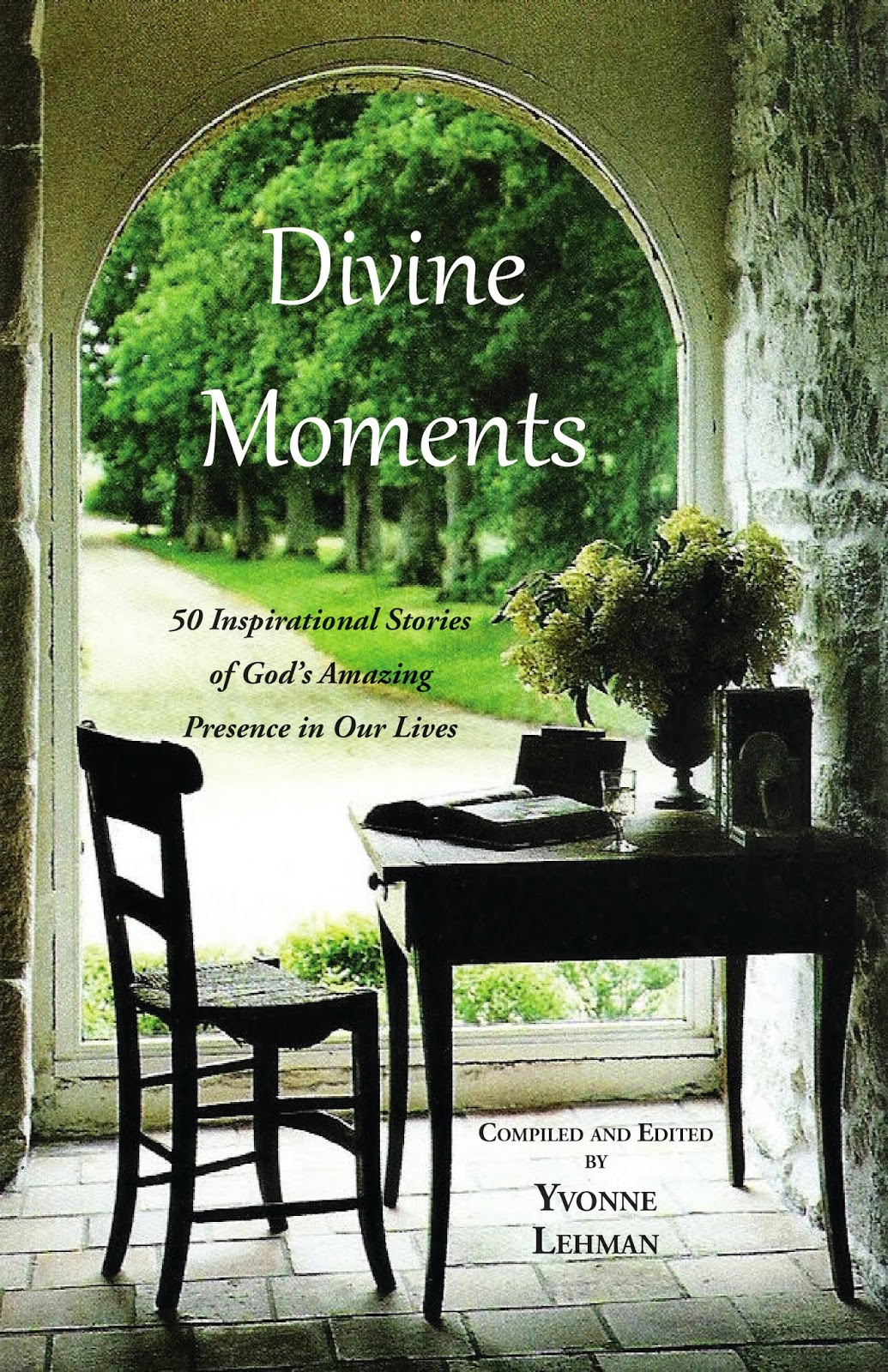
Divine Moments


by Yvonne Lehman

Some of you reading this blog know about this wonderful book just released by Grace Publishers because you are among the contributors. For the benefit of those who aren’t familiar with it’s beginning, I’d like to mention it and thank the ACFW-SC contributors.

One evening, after a day of participating in the 2013 Blue Ridge Mountains Christian Writers Conference, several us sat in the beautiful lobby of Mountain Laurel hotel on the campus of Ridgecrest Conference Center in North Carolina.

Cindy Sproles told a story that had us all gasping with amazement of how God showed up in an almost unbelievable way. Someone else, then others began to remember and share their stories. Some were sweet, some humorous, others serious, but all were about knowing his presence with us. I thought of the praise song, “Our God is an Awesome God,” in which the words are repeated over and over. I’ve often wanted to say, “Go further. Don’t just repeat the words. Tell me in what ways you are amazed by God.”

Wednesday, May 7, 2014

Use What You've Got--Learning to Write in Bits & Pieces of Time

by Edie Melson

I had always believed that I needed at least an hour, and preferably three, to make any progress at all with my writing.

I couldn’t have been more wrong.

In the past year, I’ve learned how to use the time I have, even if it’s just fifteen minutes. Today I want to share with you the things I do to increase my productivity when life intrudes.

1. Decide to use what you’ve got. This is the biggest part of the puzzle. If you wait for perfect circumstances, chances are you’ll never finish your book. Truthfully, things rarely line up. When they do—celebrate! When they don’t—just decide to work harder.

Friday, April 18, 2014

Motivation-Reaction Units (MRUs)

by Susan Craft

Here’s an excerpt from the draft of my manuscript, Laurel, before I edited it: 

Her heart sank when she noticed John standing at a distance, his expression aloof as if a curious spectator.

What’s wrong with it? The motivation-reaction is wrong. In other words, the stimulus should come before the reaction.

Here’s how it should have read:

She noticed John standing at a distance, his expression aloof as if a curious spectator, and her heart sank.

Motivation-Reaction Units, a key to compelling fiction, are created by alternating between what your POV character sees, hears, smells, tastes, or touches (the motivation) and what he does (the reaction). Motivation is external and objective (presented as if by a video camera).

In one paragraph, write motivation so your reader experiences it.
Example: The tiger dropped out of the tree and sprang toward Jack.

In a separate paragraph, write your character’s reaction, exactly as he would experience it from the inside, giving your reader insight into your character.

According to writing instructor Dwight Swain, “The reaction is more complex than the motivation. The reason is that it is internal, and internal processes happen on different timescales.   When you see a tiger, in the first milliseconds, you only have time for one thing -- fear. Within a few tenths of a second, you have time to react on instinct, but that is all it will be -- instinct, reflex. But shortly after that first reflexive reaction, you will also have time to react rationally, to act, to think, to speak.

You must present the full complex of your character's reactions in this order, from fastest time-scale to slowest. If you put them out of order, then things just don't feel right. You destroy the illusion of reality. And your reader won't keep reading because your writing is "not realistic."
Example: A bolt of raw adrenaline shot through Jack's veins. He jerked his rifle to his shoulder, sighted on the tiger's heart, and squeezed the trigger. "Die!" he yelled.

There are three parts to the reaction: feeling, reflex, and rational action -- in that order.

In our example, feeling comes first because it happens almost instantly. Reflex is a result of the fear and requires no conscious thought. Lastly, come rational action and speech.

You can leave out one or two of these three parts, but whatever parts you keep in must be in the correct order.

Write each scene and sequel as a sequence of MRUs. Each motivation and reaction should be followed by another motivation an reaction. You can't afford to write one perfect MRU and then be happy. You've got to write another and another and another. Reaction will lead to a new motivation that is again external and objective and which you will write in its own paragraph.

Continuing the example we've created so far: The bullet grazed the tiger's left shoulder. Blood squirted out of the jagged wound. The tiger roared and staggered, then leaped in the air straight at Jack's throat.

When you run out of motivations or reactions, your scene or sequel is over. Don't run out too soon. Don't drag on too long.

Credits: Several years ago, I took a writing class led by Dwight Swain, and much of this post is from the notes I took while there. The drawing of the man aiming at a tiger was copied from the blog, Aussiehunter.


Susan F. Craft is the author of The Chamomile, a SIBA award-winning Revolutionary War inspirational romantic suspense.

Monday, April 14, 2014

Do I Need A Critique Group?

by Andrea Merrell

Critique—a word that causes fear in the hearts of otherwise brave writers—produces tremendous results. It’s the best way to know you’re on the right track, and the easiest method to get face-to-face advice and direction from other professionals. When I meet with writers, especially those at the beginning of their journey, I hear a number of excuses for not connecting with a critique group. Here are the most common.

I'm Too Busy 

If you have time to write, you must take time to get feedback from others. The writer’s journey involves a huge commitment of time. Conferences, workshops, and online courses are important, but being part of a group is one of the best ways to learn and get inspired. Sometimes you can gain more in a few brainstorming sessions than by years of classes.

I'm Too Shy 

If you desire to be published--or even share your writing with friends and family--you will need to overcome the shyness and pray for boldness. Writing involves networking, marketing, and speaking. Take hold of your passion and let it drive you.

 I Don't Know How to Find One 

Check with your local Christian bookstore to see what they recommend. If a local group is not available, find one online. If all else fails, start a group yourself.

I Don't Handle Criticism Well 

Don't think of a critique as criticism. Think of it as a way to hone your skills and perfect your craft. Remember that the goal of the group is to help you, not tear you down. Develop a writer's rhino skin and always be open and teachable.

The Bottom Line 

Being part of a good critique group will help you overcome your fears, prepare you for conferences, and help get your manuscripts polished and ready for submission. We all have a lot to learn and the process will never end.

Ecclesiastes 4:9-10 (TEV) tells us that, Two are better off than one, because together they can work more effectively. If one of them falls down, the other can help him up. Don’t take this journey alone. Find others to come alongside you to make the experience educational and fun.


For more writing and editing tips, check out Andrea’s new book, Murder of a Manuscript, (Lighthouse Publishing of the Carolinas 2014) now available from Amazon.  http://www.amazon.com/dp/1941103057/ 


Andrea Merrell is a freelance writer and editor living in the beautiful upstate of South Carolina. She is Associate Editor for Christian Devotions Ministries and Lighthouse Publishing of the Carolinas. Andrea has led workshops at the Kentucky Christian Writers Conference (KCWC), Writers Advance Boot Camp, and The CLASS Christian Writers Conference in New Mexico. Her work has been published online and in numerous anthologies. Andrea’s next book, Praying for the Prodigal, will be released by Lighthouse Publishing of the Carolinas in 2015. To learn more about her, visit her website: www.andreamerrell.com.

Tuesday, April 8, 2014

The Ache

by Katie DePoppe

Literature is as old as speech. It grew out of human need for it, and it has not changed except to become more needed. - John Steinbeck

Last week, as I laid in bed with my 4-year-old son, he asked me to tell him a story from when I was a little girl. We’ve discussed that I used to ask my mom the same thing, so while he nearly always chooses a book over the old-fashioned oral story-telling tradition, I jump at the chance when he requests stories from my childhood.

We talk a lot about using our imagination and being creative at home, and he’s great at coming up with his own stories, but when he asks for ideas, I have to admit that I re-live my childhood vicariously in 5-minute heart-swelling increments. I’m not ashamed.

So, on that random evening last week, I was more than willing to share my “stories” with him. Most were just snippets of great memories. One of those: explaining to him how I would wait all week for my mom to take me to the Home Video each Saturday to rent one of Shelley Duvall’s Fairy Tale Theater classics. My favorite? The Six Dancing Princesses, an old classic complete with mystery, an invisibility cloak, and a secret passage way.

I watched as my little boy’s eyes widened as I told the story.

“I am so excited,” he said, and then his little face fell for a moment. “I just want to be in the story so bad, Momma.”

I told him I understood. I know that ache. More than he knows.

Over the years, there have been those stories – you know the ones – that affect you. The ones that linger long after you’ve read the last line, a shadowy friend who follows you as you go back to everyday life; the ones that seem to wrap their hands around your shoulders and pull you through the pages and hold you there for a while.

As a child, there was a storybook I spent hours poring through because the illustrations were so beautiful; I decided I wanted to live there and spent hours of my early years trying to draw pictures like those. I still remember, with great nostalgia, my eighth grade self, tucked into bed in the wee hours of the morning, brought to tears for the first time by a novel. And I could write all day about the works that I’ve read as an adult that have shaped my heart in some good way or opened my eyes to a new way of thinking.

What’s the point of this, you ask?

This post isn’t meant to teach or tell you something you don’t already know. Rather, I thought it might be nice to have a reminder interspersed amongst all the well-thought strategies and professional advice – a reminder of why we do what we do.

I hope I write something that will one day put that ache in someone’s heart, that ache I know all too well and which my son felt for the first time at 4. How easy it is to forget that literature has the power to change the world.

For more information on the power of literature
and a recent study on the power of fiction, visit http://teachthemdiligently.net/blog/2013/10/power-fiction/

Katie DePoppe is the editor at large for Azalea, a magazine that celebrates the lifestyle, history, and culture of the South Carolina Lowcountry. She spends her days working in the library basement of a local university and her nights tinkering with words she hopes will eventually appear on her personal blog, The Southern Apothecary (currently under re -construction), or in the pages of a Southern gothic short story collection. She lives with her husband and son, five dogs, twenty chickens, four peacocks, and a plethora of strays on her grandfather’s land near Charleston.  She is a member of Word Weavers International, ACFW, and is a life-long member of Sigma Tau Delta, the International English Honor Society. Connect with Katie on Twitter @KDePoppe.